If you buy through Sunbeam & Sisal links, we may earn a commission at no extra cost to you. How Sunbeam & Sisal affiliate links work
Elevated perches expand your cat’s territory without consuming living room floor space. However, turning a bare wall into an active indoor highway requires more than aesthetic appeal. Before drilling holes, you must account for dynamic landing forces, wall framing, and safe descent paths.
The Golden Rule of Cat Wall Furniture
Jumping and resting place different demands on a mounting system. Do not infer a shelf’s capacity from cat weight alone. Check the exact shelf, bracket, fastener and wall requirements together; listing photos and a general guide do not verify that installation.
Separating Route Functions: Steps vs. Loungers
Successful wall systems separate transitional movement from long-term resting. In inspiration photos, multi-shelf sets often look like continuous artistic installations. In practice, cats use distinct areas for specific behaviors:
- Transition Steps & Stairs: Narrow treads and compact steps intended strictly for climbing and descending. They do not need to accommodate curled-up sleeping, but they require reliable grip—such as sisal wrapping, grooved wood, or felt—to improve footing; traction still depends on the surface, its condition, and the individual cat.
- Observation Platforms & Loungers: Broad, deep perches where a cat can fully stretch, turn 360 degrees without feeling off-balance, and settle into a deep sleep.
- Suspended Hammocks & Slings: Flexible canvas or plush perches. While popular for sleeping, they flex under shifting weight; jump landings directly into a loose hammock can startle skittish cats, making them better positioned as gentle endpoints rather than launch pads.
Evaluating Common Wall-Mounted Designs
Marketplace offerings range from multi-piece starter bundles to individual stairs and hammocks. When browsing seller listings, treat photos and descriptions as unverified claims: hardware, exact wood species, and stated weight ratings must always be confirmed against the physical item before installation.
1. Multi-Piece Starter Sets
Bundled sets typically feature climbing stairs, box houses, and small perches. They provide an immediate variety of levels, making them convenient for owners starting with an empty wall. The trade-off is layout complexity: each component has its own screw pattern, meaning you must carefully plan how bracket holes align with your wall studs.
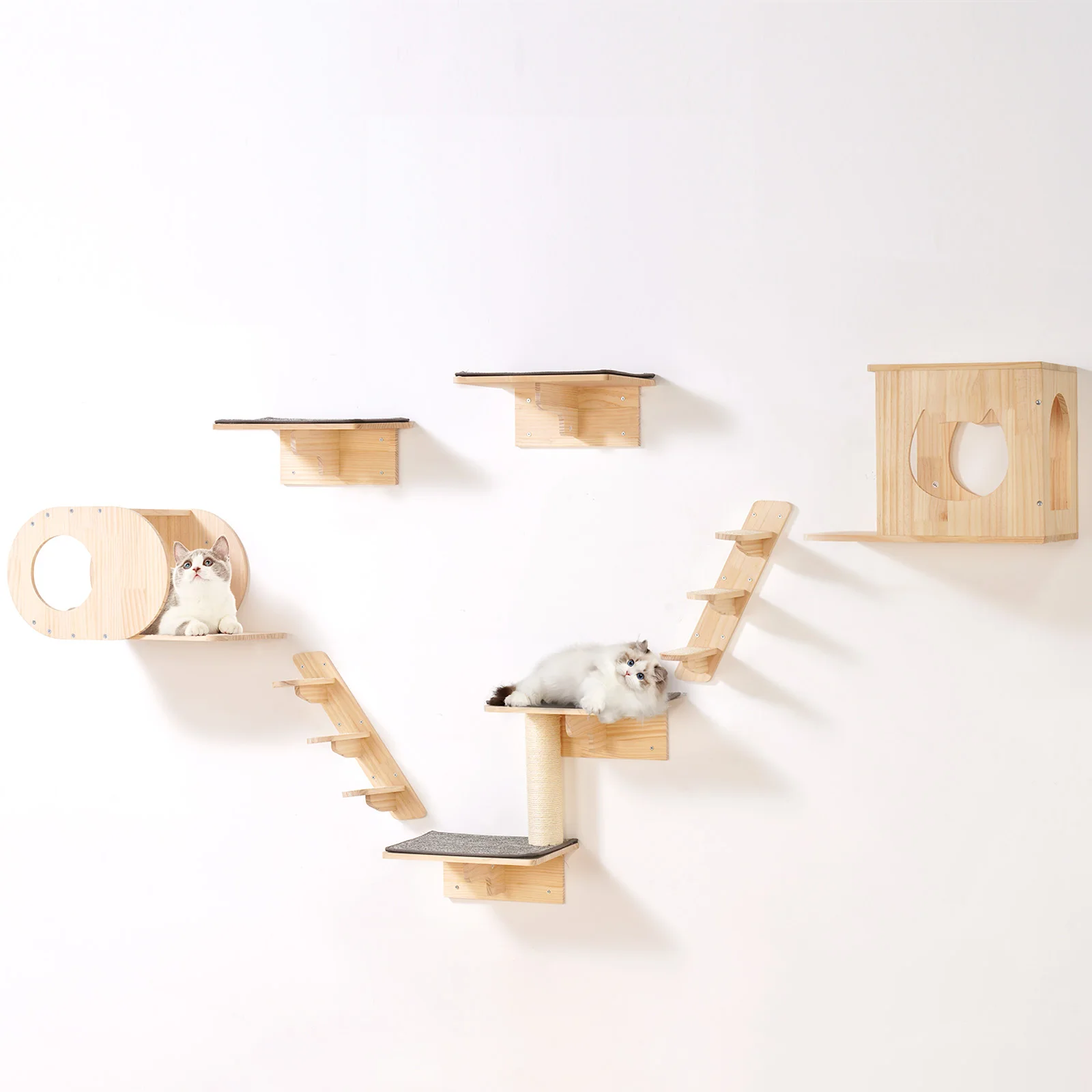
Buyer verification check: obtain the mounting-hole layout and installation instructions before buying. Compare them with the actual wall construction; included plugs alone do not establish that the fixing system is suitable.
2. Directional Stairways and Climbing Ramps
Stepped assemblies with sisal-wrapped treads give cats a structured incline to gain elevation without demanding single, massive vertical jumps. They are particularly useful for kittens, senior cats, or homes where you want a gradual route up to a high window perch.
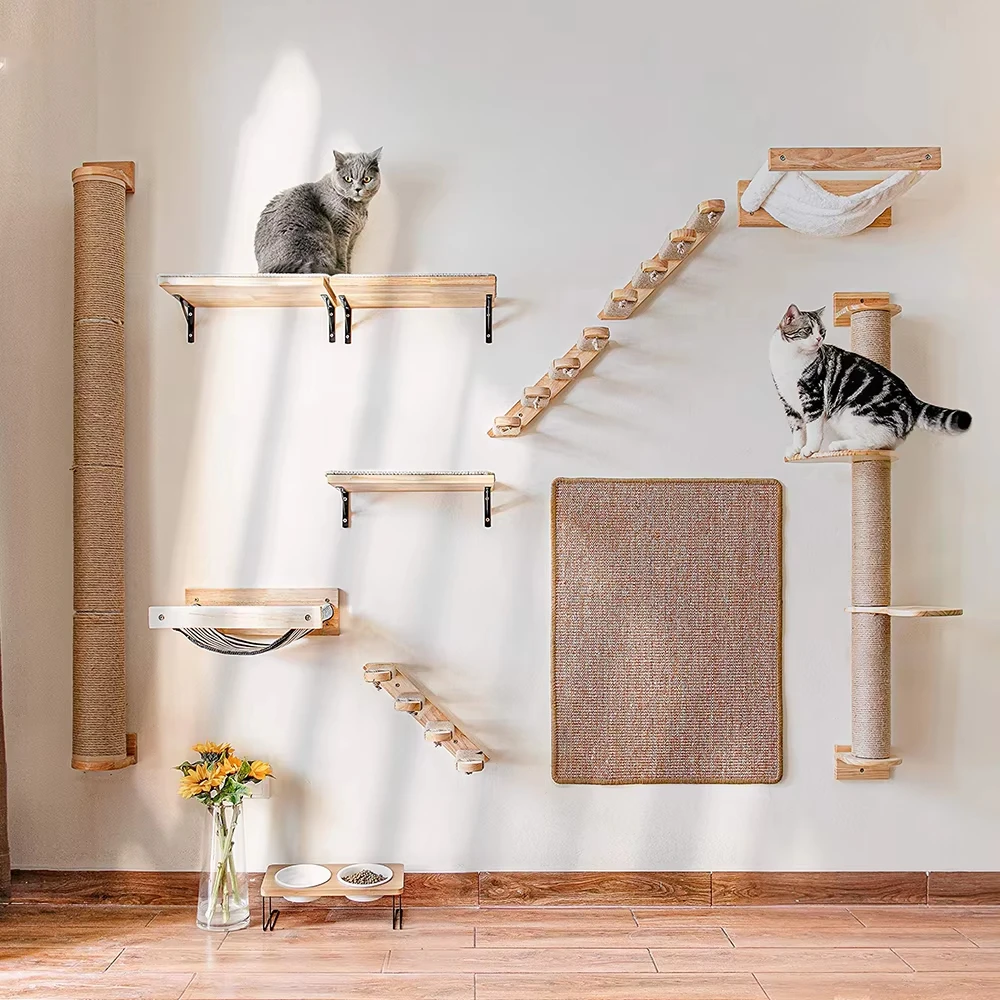
Buyer verification check: ask how the exact bracket and fixing system should be installed in your wall type. Do not select an anchor solely from its appearance or a general product photograph.
3. Wall-Mounted Canvas Hammocks
A suspended fabric hammock provides a contouring, cozy resting place. Because the fabric suspends between two projecting arms, the leverage pulling on the wall mounting plate is constant whenever the cat is inside.

Buyer verification check: Confirm whether the fabric sleeve is easily removable for washing, and check that the wooden projecting dowels are secured with threaded hardware rather than simple press-fit joints.
4. Curved Loungers and Modular Playgrounds
Curved bentwood designs and padded platforms cater to lounging aesthetics while blending cleanly with contemporary home interiors. Shaped cradles help cats feel secure while sleeping off the ground.
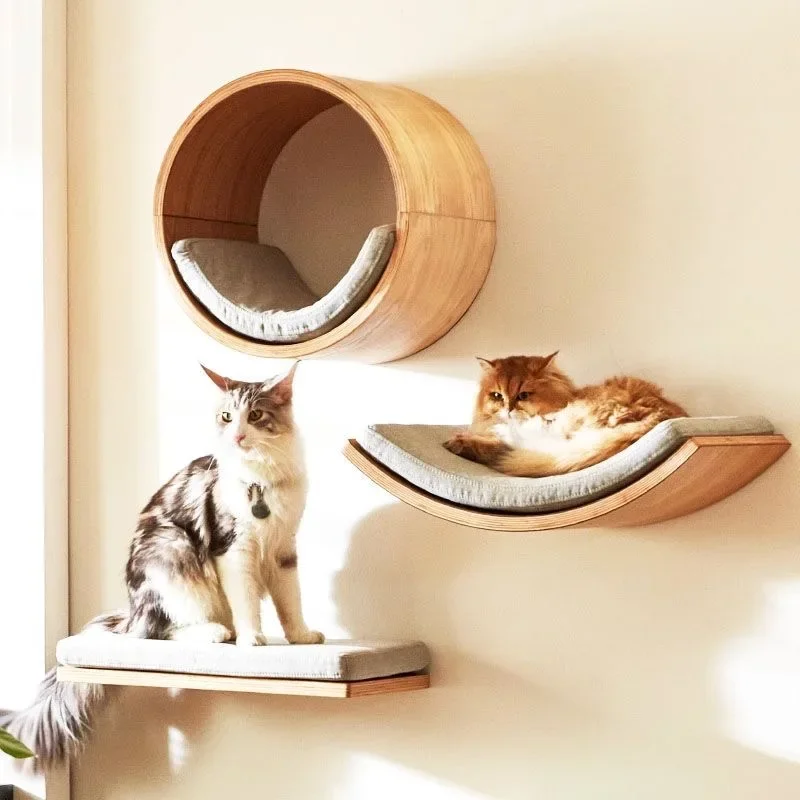
Buyer verification check: Smooth, varnished wood finishes can be slick. Verify if cushions or traction pads attach securely via hook-and-loop fasteners or non-slip backing so they do not slide under a jumping cat.
Mounting Mechanics: Behind the Drywall
Shelf design, fasteners, wall material and installation all matter. Fischer’s safety guidance explains that its published loads depend on installation conditions and the appropriate fixing combination. This general principle does not certify the marketplace shelves here; obtain their applicable instructions and qualified help when needed.
| Wall condition | What to verify before purchase |
|---|---|
| Timber framing | Check the mounting pattern and manufacturer-approved fixing requirements against the actual structure. |
| Hollow wall | Identify its construction and obtain documented requirements for the shelf and fixing system. Generic included plugs do not verify suitability. |
| Masonry | Confirm the material, its condition, compatible fixings and installation instructions. Ask a qualified installer when these are uncertain. |
Follow the selected shelf and fixing manufacturer’s installation and inspection instructions. A hand push is not a measured capacity test. If the wall construction, bracket layout or fixing requirements are uncertain, have a qualified installer assess them before allowing pets onto the shelves.
Designing a Round-Trip Route Your Cat Can Actually Use
Climbing up is instinctive; climbing down requires confident footing and spatial planning. According to route-planning guidance from Webvet's layout analysis, dead-end vertical systems frequently trigger territorial bottlenecks or leave less agile cats stranded up high.
1. Accessible Launch & Landing
Plan an accessible starting point suited to your cat’s mobility. A stable furniture surface or intermediate platform may help, but choose the layout for the individual cat rather than relying on a universal jump-height rule.
2. Turning Clearance
A cat needs enough physical landing room to pivot without hesitation. If a platform is narrow, arrange vertical transitions in a gentle zig-zag or spiral rather than placing steps directly above one another, which blocks clear headroom.
3. Safe Multi-Cat Egress
In multi-cat homes, a single high shelf with only one ladder can become a trapped perch if a dominant cat blocks the exit. Provide two separate ascent/descent paths or link the shelf to a nearby credenza or cat tree.
Pre-Purchase Verification Checklist
Before checking out, compare the product specifications on the seller page against your room’s structural layout:
- Bracket Hole Spacing: Do wide shelves have mounting points that match standard 16-inch stud intervals, or will at least one side require a heavy toggle anchor?
- Platform Dimensions: Is the designated sleeping shelf large enough for your cat to turn and rest comfortably so your cat can rest comfortably?
- Surface Traction: Is the wood bare and slick, or does the product include secure carpeting, grooved channels, or sisal pads?
- Wall Clearance: Does the path clear opening door arcs, hanging wall mirrors, ceiling fans, or curtain rods?
- Wiring & Plumbing Awareness: Is your chosen path clear of vertical stud cavities containing electrical wiring above light switches or behind shared bathroom walls?
Editorial Notice: Product details, current prices, and listing claims reflect marketplace data as captured on October 12, 2026. This guide provides structural planning and product comparisons; always verify hardware specifications with the manufacturer’s documentation and confirm the installation requirements for your specific wall construction before allowing pets onto elevated installations.